


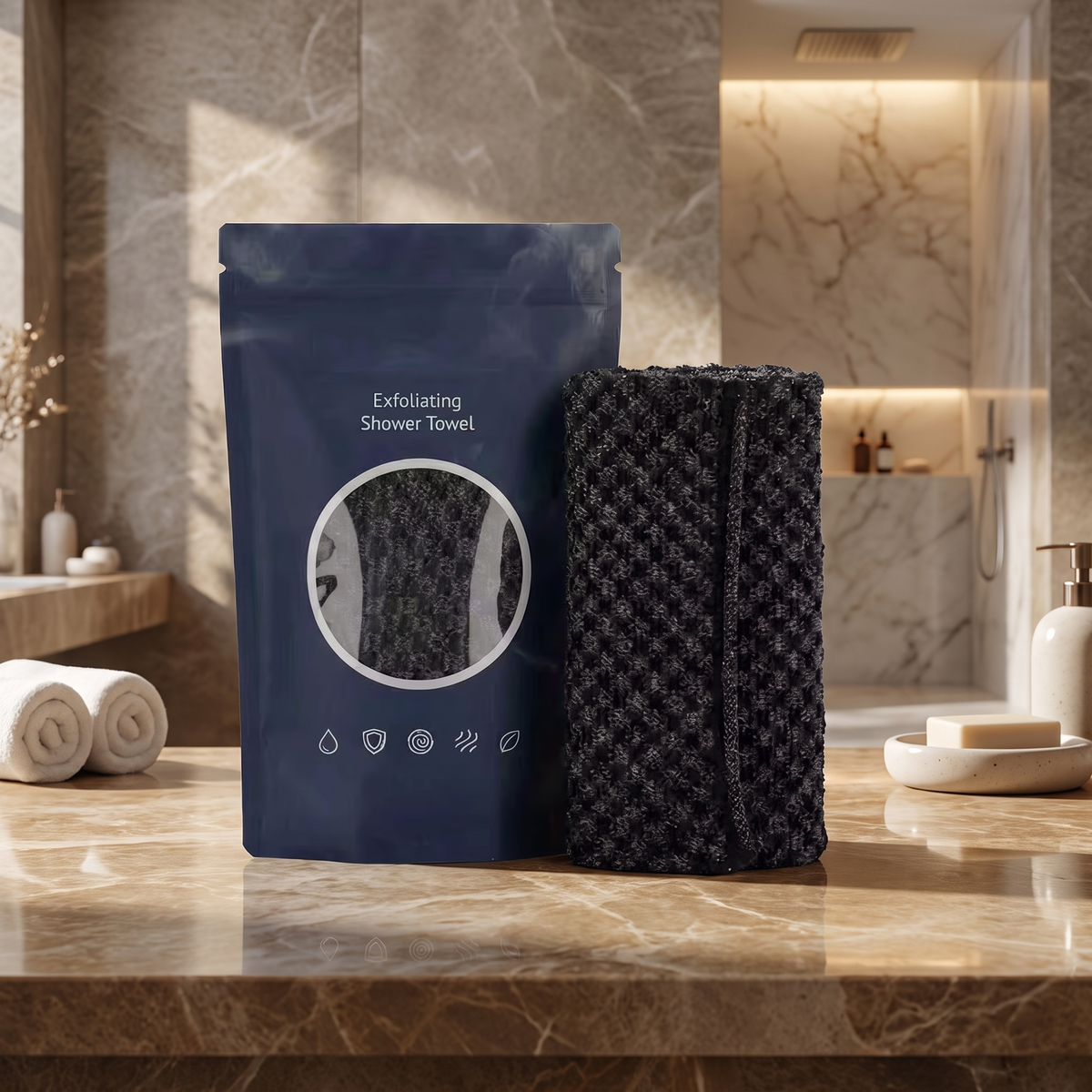

The first time, you won't believe what comes off.
Run it over your arm. Look at the towel. That grey film is what your body wash has been sliding over every day for years — dead skin, sweat residue, whatever's left of yesterday's lotion. Soap dissolves oil. It does not lift a layer. That's a job for texture, and it takes about ninety seconds.
Nevoros vs. Your Ordinary Shower Loofah
A shower puff/loofah holds water in its core for hours, along with everything you just scrubbed off. That's why it starts to smell, and why it never really exfoliates.

|
Loofahs & puffs | |
|---|---|---|
Lifts dead skin and buildup, not just surface dirt |
||
Reaches your entire back unassisted |
||
Dries fully between showers |
||
Rinses completely clean — nothing trapped inside |
||
Machine washable |
||
Holds its texture over time |
Questions people ask
Does this actually do anything a washcloth doesn't?
Yes, and it's structural. A cotton washcloth has a flat pile that glides over dead skin. Nevoros uses a textured carbon-fibre weave with raised ridges that catch and lift the layer of dead cells and product residue sitting on your skin's surface. You'll see it come off the first time you use it. No acids, no grit, nothing left behind on your skin.
Is it too rough for sensitive skin?
It's firm, not sharp. Use the fine side and light pressure — the weave does the work, so pressing harder doesn't help and can leave you red. Start with three sessions a week and build from there. It isn't designed for facial use.
How is it more hygienic than my loofah?
A loofah's dense core holds water for hours and traps the skin cells you just removed — that's why it starts to smell. Nevoros is a single open-weave layer weighing 45 grams. It rinses clear and dries fast, so there's nothing left inside it to go stale between showers.
Do I need to replace it like a loofah?
Not on the same schedule. A puff breaks down because it stays wet and the mesh collapses. Nevoros goes through the machine and comes out with its texture intact. Wash it cold and skip the fabric softener — softener coats the fibres and flattens the texture that does the work.
How do I use it?
Wet the towel, add a small amount of body wash, and work in long strokes over wet skin. Hold it at both ends to run it across your back. Concentrate on the places that build up: elbows, knees, heels, shoulders. Rinse it out, hang it up, done. About ninety seconds.